

When Kelechi Iheanacho fired Celtic’s dramatic late winner to keep the Scottish Premiership title race alive heading into the final day, the players, staff, and fans went wild.
But there was another detail visible in celebrations seen across broadcasts, social clips and global media photos:
The STATSports performance vest.

Moments like this are exactly why elite clubs and athletes invest so heavily in athlete monitoring technology.
Because the ability to still sprint, press, recover and perform deep into games after 90+ minutes of football is vital, and the technology helps guide that training and match-day performance.
Why Elite Clubs Monitor Physical Load
Modern football is faster and more demanding than ever. A 10-year study by Arsenal’s Head of Sport Science, Tom Allen, found that high-intensity running has increased by up to 40%.
Players now cover huge distances at high speed while dealing with congested schedules, travel, recovery demands, and constant tactical pressure.
Monitoring physical load helps clubs understand how much stress players are placing on their bodies during training and matches.

Using wearable GPS technology, clubs can track metrics like:
- Total distance
- High speed running distance
- Sprint distance
- Accelerations and decelerations
- Top speed
- Dynamic movement load
- Repeated high intensity efforts
The goal isn’t just collecting numbers for the sake of it.
The real value comes from helping coaches and sports science staff answer practical questions:
- Is a player recovering properly?
- Is training intensity too high or too low?
- Can a player physically cope with match demands?
- Is fatigue starting to build?
- Does a player need more exposure to sprinting?
- Can performance levels still be maintained late in games?
Research across elite football has repeatedly shown that monitoring external training load can help practitioners better manage fatigue, guide recovery, and reduce injury risk across long seasons.
Why Real-Time Data Matters
Traditionally, teams would wait until after training to download and review data. Now, many elite environments monitor player loads live during sessions.
That changes everything. Instead of reacting after the fact, coaches can make adjustments immediately.
If a player’s sprint distance is too low relative to their individual profile, staff can increase it. If fatigue markers start appearing, loads can be reduced before players are pushed too far.
Recent research around real-time athlete monitoring has highlighted the growing importance of live GPS data for identifying fatigue trends and informing decision-making during both training and match scenarios.
In simple terms: elite clubs are no longer guessing. They’re making informed decisions using live physical data.
This Technology Is No Longer Just for Elite Players

For years, GPS tracking was something only professional clubs had access to – that’s now changed.
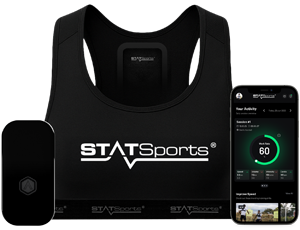
The same core technology used throughout elite football is now filtering into semi-pro, academy, college, grassroots and amateur environments via our STATSports Academy GPS Tracker for individual players.
And the reason is simple: players at every level want answers.
- Am I fit enough?
- Am I training hard enough?
- How fast am I actually?
- Can I maintain intensity late in games?
- What separates me physically from higher level players?
That’s where athlete monitoring becomes useful outside the pro game.
What Amateur Players Usually Get Wrong

Most players think they’re training hard because they feel tired – that’s not always true.
Without objective data, it’s very difficult to understand:
- training intensity
- sprint exposure
- workload consistency
- recovery demands
- match fitness
A player might think they’re doing enough high speed work during training, when in reality they rarely hit the physical outputs required in matches.
That gap matters, especially late in games, and particularly during decisive moments.
Football Is Increasingly Decided by Physical Margins

The technical gap between players is often smaller than people think.
What increasingly separates players is the ability to repeatedly perform high intensity actions under fatigue.
Can you still sprint in the 90th minute?
Can you recover fast enough to do it again?
Can you physically repeat those efforts week after week?
That’s why load monitoring has become such a huge part of modern football.
Not to replace coaching instinct, like some think, but to support it with objective information. And now, that same approach is becoming accessible well beyond the elite game.
STATSports Academy GPS Tracker Available To Buy Now

Whether you’re playing academy football, semi-pro, grassroots or Sunday league, the same approach to performance tracking is now available beyond the elite game.
The STATSports Academy GPS Tracker allows players to monitor key metrics like distance covered, top speed, sprint distance and high speed running, while the STATSports Academy app helps turn that data into actionable training insights with fitness training plans and drills, plus recovery & nutrition guidance.
Share article