

There’s a problem with how most players interpret their physical data after a game.
They look at total distance. They look at top speed. Maybe they check their sprint count. And then they draw a conclusion – “good game” or “poor game” – based on numbers that, on their own, are almost meaningless.
Dr Paul Bradley’s research on the physical performance of Premier League footballer at spent years making the case against this approach. The argument, in short: raw physical output without tactical context isn’t analysis. It’s just numbers. A player covering 11km could have spent 60% of that distance in the wrong areas. A player with five sprints could have made every single one of them count – or none of them.
What you need is a little context. Where the work happened. What it was in service of.
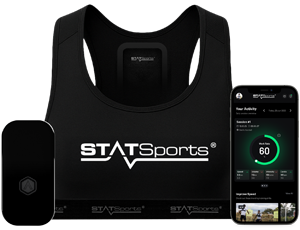
The two new features just added to the STATSports Academy app are built around exactly that principle.
Heatmap & Zone Analysis
 The Heatmap shows you a visual map of where you covered ground during your session – plotted directly onto the pitch. It’s a breakdown of how what space you worked most in.
The Zone Analysis sits alongside it, splitting your activity into thirds: how much of your work happened in the attacking zone, the middle third, and defensively.
That split matters more than most players realise. Bradley’s research established that high-intensity running profiles are position-specific at the elite level – and that analysing players by their specific tactical role rather than a general position reveals a completely different picture of their demands.
A central attacking midfielder and a central defensive midfielder look nothing alike when you break down where they’re covering high-intensity ground. The CAM’s work is front-foot and transitional; the CDM’s is more about covering space through the middle and across the pitch. It’s the same general position, but it’s a completely different physical-tactical footprint.
The Zone Analysis gives you that same lens on your own game. If you’re a midfielder and your zone split shows 20% attacking third, 60% middle, 20% defensive – that’s a story. If the defensive third is 40%, that’s a different story. Neither is necessarily wrong. But knowing the split means you and your coach can have a real conversation about whether your movement patterns are matching the brief.
It also opens a question worth asking: are you actually carrying out your tactical instructions? Kane’s heatmap from the PSG semi-final tells that story clearly – spread wide, dropping deep, stretching the defensive structure for 85 minutes before being in exactly the right place in the 94th minute. Everything Vincent Kompany would have asked of Kane. The physical data and the tactical output are inseparable. Your zone split tells you the same thing about your own game.
Sprint Map
 The Sprint Map plots every individual sprint from your session as a directional arrow on the pitch. Direction, location, the best effort flagged automatically – with time, top speed, and duration attached to it.
This is where the Bradley research becomes genuinely useful in framing what you’re looking at.
His contextualised analysis of Premier League match data found that roughly 30-40% of high-intensity running at elite level is done when recovering into a defensive position – transitional work, getting goal-side, closing the space after a turnover. A further ~15% is done in support of play while in possession – making runs to create options, occupying space, giving the ball-carrier an out.
That’s over half of all elite high-intensity running accounted for by two tactical purposes most players never think about when they look at their sprint data.
The Sprint Map lets you start asking those questions about your own sessions. Look at the direction of your sprint arrows. How many of them were recovery runs – tracking back, getting behind the ball? How many were forward runs in support of a teammate in possession? Where on the pitch were your best efforts happening? Were your sprints concentrated in the first half or second? Were they positionally consistent – telling you something about your role – or scattered?
A player with five sprints who made three recovery runs and two attacking runs in the right moments has contributed more to their team’s defensive and offensive structure than a player with fifteen sprints made at random. The Sprint Map begins to show you the difference.
The Shift From Output to Understanding
 The traditional approach to match physical data – looking at distance, speed, sprint count in isolation – has dominated amateur and semi-professional football analysis for decades. Bradley’s research programme made the case that the elite level moved on from this, not because those numbers aren’t useful, but because they only answer what. The more important questions are where, when, and why.
The Heatmap and Sprint Map features bring that shift into the STATSports Academy app. You now have the tools to move beyond reviewing your output and start understanding your game.
Available now in the STATSports Academy app. Download and connect your Apex Pod to start building your physical-tactical profile.
Share article