

If you’ve ever watched a Premier League game and wondered what actually separates the players who get to the ball first from the ones who don’t, the answer is more specific than “they’re fast.”
Once you understand what the research says, you can start training for it yourself.
Start with the numbers. Research analysing 360 goals across the German Bundesliga found that 83% were preceded by a powerful physical action from either the scorer or the assister, and a straight line sprint was the single most common action involved, present before 45% of all goals scored.
Nearly half of every goal in the world’s most data-driven league starts with a player sprinting in a straight line before the ball even arrives. Raw linear speed is a foundation for anyone who wants to be on the end of a chance or the one creating it.
But raw speed only gets a player so far, and this is where Paul Caldbeck’s research picks up the story.
Caldbeck spent years as Physical Preparation Lead at a Premier League club, and his doctoral research at Liverpool John Moores University dug into something most amateur training programmes completely ignore: contextual sprinting, or what elite performance staff now call “game speed.”
A 40m sprint down a straight line tells you a lot about a player’s ceiling, but not the whole picture of whether they can actually win the ball back or get in behind a defence during a real game.
Caldbeck’s research found that the vast majority of sprints in match play involve some degree of curve, not a straight line, and that the reason a player sprints (chasing a ball down the channel, closing a gap, breaking from a defensive line) shapes the movement itself.
Build the raw capacity through linear sprinting, and layer on top of it the curved, reactive, in-game movements that actually decide matches.
Want a structured way to build that raw top-end speed before layering in the contextual work? Download our free 4-week Speed Development programme and start building the foundation elite players train first.

Training It Yourself, Away From Team Sessions
This is exactly where a lot of young players fall down, not through lack of effort, but lack of information. Team training is built around the group. It’s rarely going to give an individual player the volume of maximal sprinting, curved running, or targeted speed work that their specific physical profile needs.
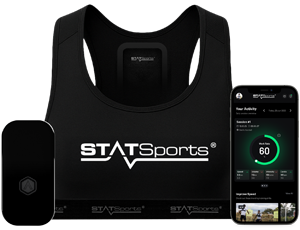
This is where wearing a STATSports Academy GPS tracker during your own individual sessions changes the game. It gives you the same kind of data a Premier League performance department would use, just built for you as an individual athlete:

- Top speed and acceleration profiling – see your actual max speed, so you know exactly where your ceiling currently sits
- Speed zone breakdown – track how much time you spend sprinting, high speed running, and jogging, so you can tell if a session actually delivered the exposure you needed
- Session-to-session tracking – build a training log that shows whether your speed capacity is genuinely improving over weeks and months, not just how tired you felt
If you know from the research that curved and reactive sprinting matters more than straight-line speed alone, you can go and design your own extra sessions, whether that’s a local track club night for pure top-end speed, or a self-led curved running and change of direction circuit, and then use your tracker to confirm you actually hit the numbers that matter.
What This Means For Coaches Building Sessions

Caldbeck’s research also gives coaches a better language to work with.
The smart approach is to reverse-engineer training from the actual sprinting contexts your players face on matchday, then use GPS data to ensure the programme is delivering that stimulus and not overloading anyone in the process.
A few ways this plays out practically with STATSports GPS technology:
- Load management – track total high-speed running and sprint distance across the week so you’re not stacking maximal effort days on top of each other without recovery
- Injury prevention – Caldbeck is direct about this: exposing players to genuine maximal sprinting isn’t optional extra work, it’s protective. Monitoring sprint volume and intensity helps you build that exposure in progressively rather than leaving it to chance, which is one of the more overlooked factors behind hamstring injuries in youth and amateur football
- Session design around context, not just distance – use acceleration, deceleration, and change of direction metrics to check whether your small-sided games and drills are actually replicating matchday demands, or just building fitness in a shape that doesn’t transfer
- Individualising within a team setting – not every player needs the same speed exposure. GPS data lets you spot who’s under-exposed to high-speed running relative to their position and adjust their programme without redesigning the whole session
The Bigger Point
The clubs at the top of the game aren’t just training players to be fast. They’re training them to be fast in the moments that actually decide matches, and they’re using data to make sure that training is landing correctly and safely.
You don’t need access to a Premier League performance department to train this way.

With a STATSports Academy GPS tracker, you can bring the same evidence-based approach to your own individual development, and coaches can bring it to their whole squad, building sessions that are genuinely informed by what elite sports science tells us about how the game is actually won.

Share article