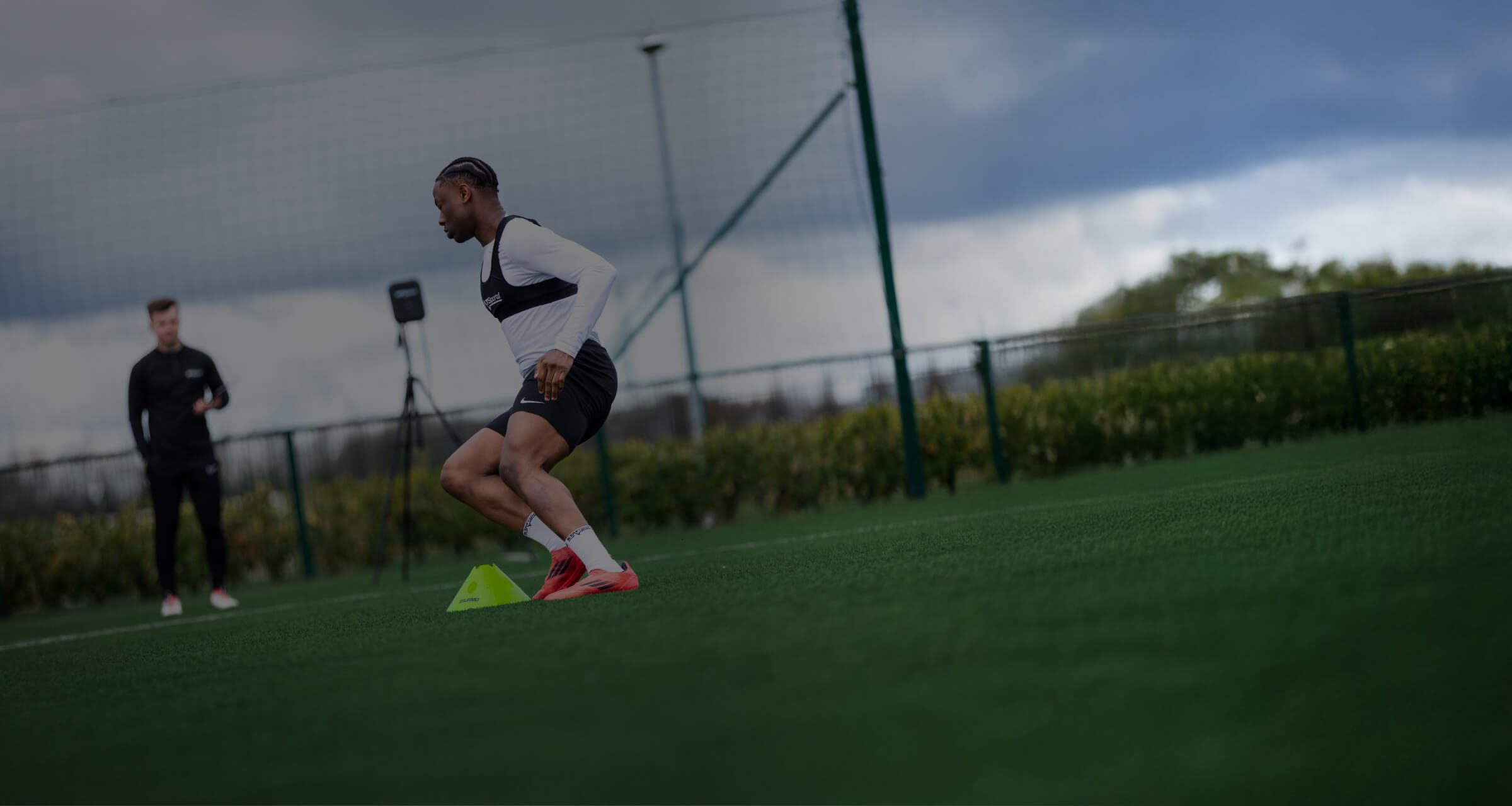
In modern football, GPS data gives us an increasingly detailed picture of the physical work performed by players.
Total distance, high-speed running, sprint distance, accelerations, decelerations and maximum speed all help us understand the demands of training and competition.
Within the Lithuanian national-team environment, these metrics are very important to us. But we also believe they are only the beginning of the story.
Our aim is to move from simply asking how much a player ran to understanding when they ran, where they ran, why they ran – and what they did when they got there.
Managing the training dose
The first part of our process is making sure players receive the appropriate physical stimulus.
This is particularly important in international football. Players arrive from different clubs, leagues and competitive schedules, often with very different recent training and match exposures. Unlike at club level, we have limited time to prepare them.
For each player, we work with individual benchmarks across the match-day cycle – MD-4, MD-3, MD-2, MD-1, MD and recovery days.
Using STATSports live monitoring during training, we can follow key metrics in real time and understand whether players are progressing towards the physical stimulus planned for that day.
This allows us to adjust when necessary. If an important exposure is missing, we can provide an additional stimulus. If the player has already achieved what we wanted from the session, there is no need to add unnecessary load simply to increase the numbers.
We also review the accumulated weekly load, rather than analysing every session in isolation.
This helps us understand whether the distribution of work across the microcycle was appropriate and whether the player received the exposures we planned.
The principle is simple:
PLAN → MONITOR LIVE → REVIEW → ADJUST
Our objective is not to maximise training load.
We are looking for the minimum effective dose – enough stimulus to prepare the player for competition while avoiding unnecessary fatigue.
But this creates another question.
Is reaching the physical target enough?
For us, the answer is no.
Level 1: Can you run?
This is the first level of our performance model.
Can the player physically meet the demands of international football?
GPS provides us with an objective answer.
We can evaluate whether players accumulate the required running volumes, reach appropriate high-speed and sprint exposures and demonstrate the physical capacity necessary for their position and role.
This information is essential.
But imagine that two players both accumulate 300 metres of sprint distance during a match.
From a traditional physical report, their output might appear very similar.
But were those 300 metres produced through the same football actions?
Almost certainly not.
And this is where the analysis becomes much more interesting.

Level 2: Can you run at the right time and in the right place?
For this, one of the important tools we use is STATSports Sonra Video Manager.
It allows us to connect our GPS data with match video and go directly from a physical event to the football action in which it occurred.
We can identify a sprint in the data and then immediately examine its context.
Why did the player sprint?
Was it a recovery run after losing possession?
A pressing action?
An overlap?
A run behind the defensive line?
An attacking transition?
A movement to create space for a teammate?
Suddenly, a sprint is no longer just a number.
Two players may produce the same sprint distance while contributing to the game in completely different ways. Even two sprints from the same player at the same speed can have completely different purposes.
This is why we don’t want to evaluate physical performance only through metres and thresholds.
The GPS tells us what happened physically. Sonra Video Manager helps us see what football action was behind that physical output.

Then, as coaches, we can ask the most important question:
Was it the right action?
Was the run made at the right moment?
Was it into the right space?
Was it what our tactical principles required from that player in that situation?
For us, this represents the second level of performance.
It is no longer simply: Can you run?
It becomes: Can you run at the right time and in the right place?
Level 3: Can you execute?
There is still one more level.
A player can have the physical capacity to make the run. They can recognise the correct situation and make the correct run.
But football does not finish when the sprint finishes.
What happens when the player gets there?
Imagine a winger making a high-speed run behind the defensive line.
At Level 1, we know they had the physical capacity to produce the sprint.
At Level 2, GPS combined with Sonra Video Manager allows us to see that the run occurred at the right moment and into the right space.
Level 3 asks:
What did the player do next?
Could they control the ball at high speed?
Did they recognise the next situation?
Did they make the correct decision?
Could they deliver the cross, final pass or finish?
The same principle applies defensively.
A defender may produce a 30-metre recovery sprint. The physical output may be excellent and the decision to recover may be tactically correct.
But did they then successfully defend the situation?
This is where physical performance becomes inseparable from football performance. From metres to football performance
For us, the process can therefore be viewed through three levels:
LEVEL 1 — CAN YOU RUN?
Can you meet the physical demands?
↓
LEVEL 2 — CAN YOU RUN RIGHT?
Can you produce the required physical action at the right time and in the right place?
↓
LEVEL 3 — CAN YOU EXECUTE?
Can you successfully perform the football action when you get there?
Another way we describe the progression is:
METRES → ACTIONS → DECISIONS → EXECUTION
The metres provide the objective physical information.
The video gives those metres football context.
Then coaching analysis allows us to evaluate the decision and the quality of execution.
This is also important when we return to training.
It is not enough to know that a player needs a certain amount of high-speed running or sprint exposure. We want to understand which football situations create those demands and, where possible, design training that prepares players for those actions.
A wide player and a central defender may both need exposure to high speed, but the football situations producing that speed can be very different.
That context matters.

The number is the beginning, not the answer
Technology gives us more information about players than ever before, but more data does not automatically mean better decisions.
For us, STATSports has value at both ends of the process.
During training, live monitoring helps us manage the dose – making sure players receive enough of the required stimulus without accumulating unnecessary load.
Across the microcycle, we can review how that load has been distributed.
And through Sonra Video Manager, we can move beyond the physical number and examine the football actions behind it.
Ultimately, football is not an athletics competition.
The best performance is not necessarily produced by the player who runs the most.
Physical capacity gives a player the ability to get there.
Game understanding determines where and when to get there.
And football quality determines what they do when they arrive.
Can you run? Can you run right? Can you execute?
That is where physical performance becomes football performance.
Author Bio

Author Bio
Georgas Freidgeimas
Head of Physical Performance, Lithuania Football Federation
Share article